
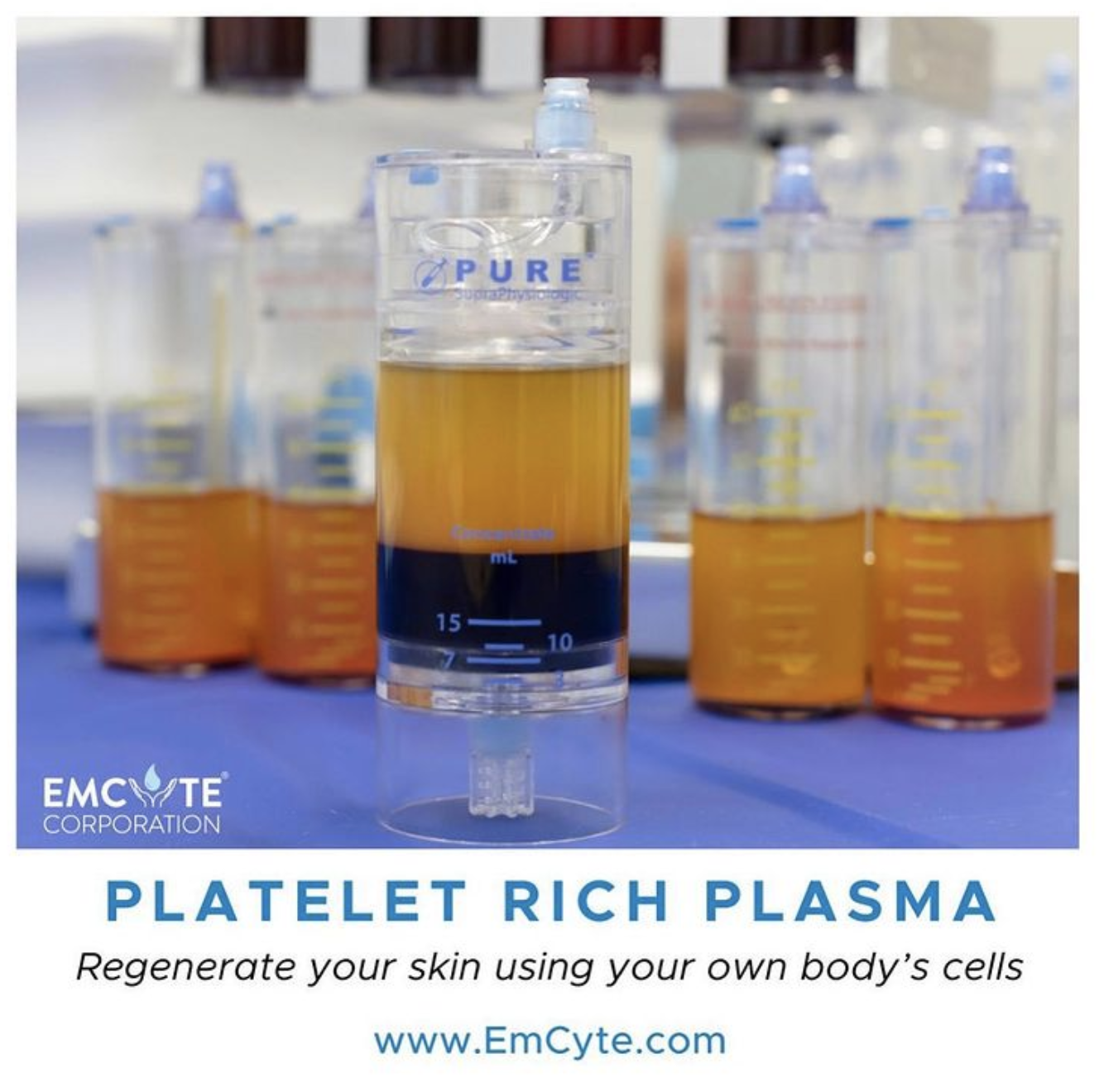
Platelet Rich Plasma Therapy PRP
EmCyte Pure® PRP at Skin Rehab™
PRP stands for platelet rich plasma. It is made from a small sample of your own blood.
Platelets are the part of your blood that arrives first when tissue is injured. They carry the signalling proteins involved in your body's normal repair processes: clotting, calling in the cells that do the repair work, building new blood supply, and laying down and reorganising tissue.¹˒²
PRP concentrates those platelets and delivers them into the tissue being treated. Nothing foreign goes in. It is your own blood, separated and returned to you.
Platelet-rich plasma is classified in Australia as a blood component and is regulated as a medicine by the Therapeutic Goods Administration. The concentrating system is a device. The platelet concentrate prepared from your own blood is not.²²˒²³
A protocol, not just a procedure
Plenty of clinics offer PRP. What varies is everything that happens around the injection.
We work out what we are treating first. A full history, a proper examination, and a conversation about what is actually going on. With hair and scalp concerns especially, the cause changes everything.
A doctor reviews you. A registered medical practitioner reviews your history and medications and approves your treatment before it goes ahead.
A Registered Nurse supervises. Your blood collection, the preparation and the treatment all happen with a Registered Nurse on site.
We prepare it the same way every time. PRP is not one thing. How it is processed changes what you receive, and published comparisons of commercial systems have found substantial differences in platelet and growth factor content between them.⁴⁻¹⁰ We use a patented closed system and document the preparation before and after every treatment.
We plan the course upfront. Number of sessions, spacing and total cost, in writing, before you start.
We review. We check how you are going against what we set out to treat, understanding that regeneration is a biological process requiring both initiation and maturation.
Thorough, compliant and consistent. That is where the difference is.
It's the distinctive processing capabilities of Pure® PRP that truly sets EmCyte apart. It stands out as the sole system available that can:
Achieve clinical platelet concentrations exceeding 7-9 times the platelet baseline in a 7-mL PRP, translating to about 1.4 million platelets/µL. Effectively remove up to 99% of RBCs and 98% of inflammatory neutrophils. In just 7 mL of Pure® PRP, one can obtain an impressive average of 10 - 20 billion deliverable platelets. A high count of deliverable platelets amplifies the activity of growth factors, which in turn boosts tissue repair.
While you may come across discounted tube systems on the market labelled as PRP or PRF, many of these systems yield only plasma with minimal platelets and do not provide therapeutic outcomes. Make informed choices and exercise caution!
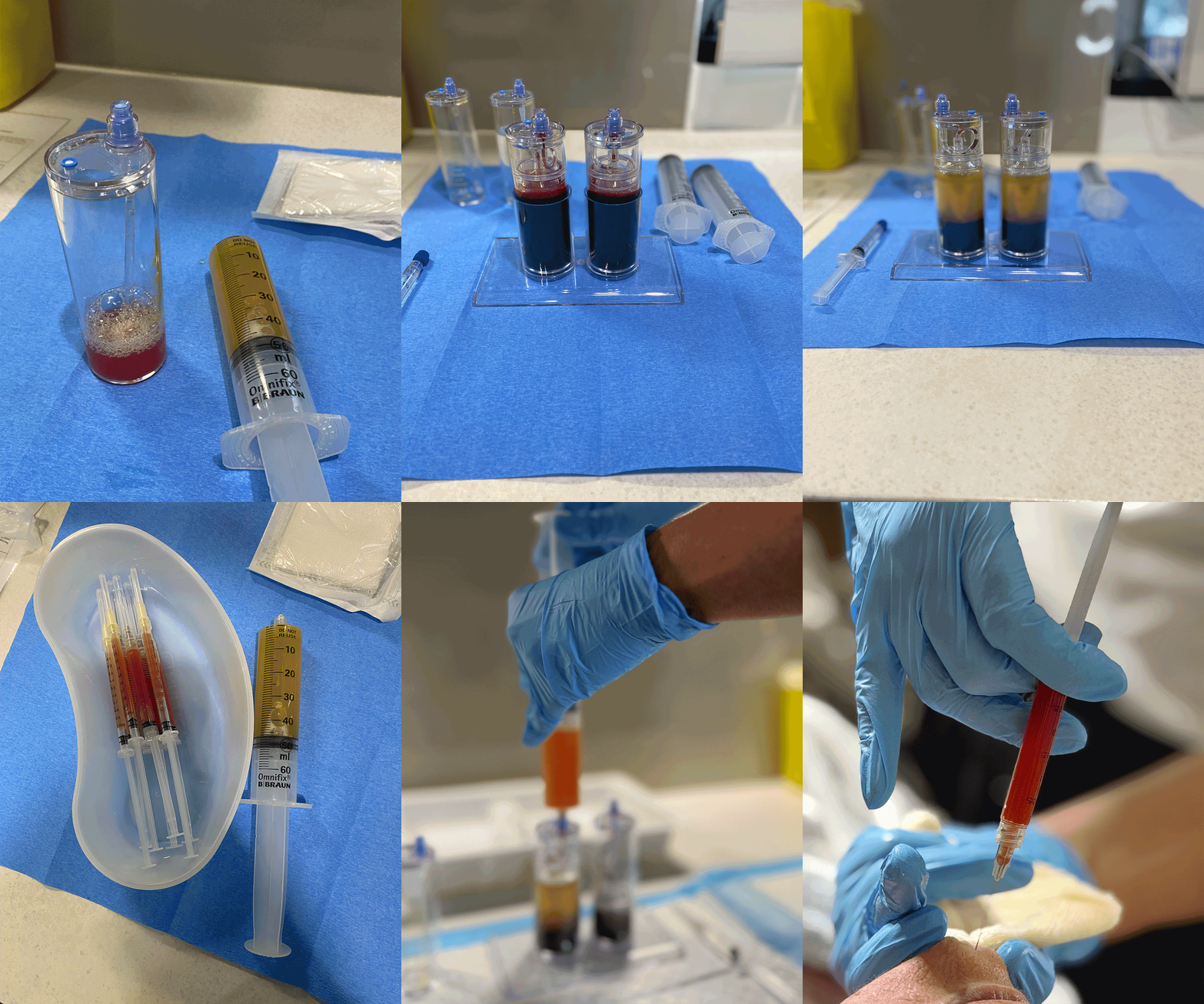
How we prepare your PRP
We use the EmCyte PurePRP® SupraPhysiologic system, a sealed single-use kit. Your blood stays in a closed system from the moment it is drawn.
It is spun twice to separate and concentrate the platelets. Nothing is added except the anticoagulant that stops it clotting while we work. Nothing is grown or cultured. Collected, prepared and returned to you in the one appointment.²⁴
The manufacturer specifies that the system produces platelet concentrations in the order of seven to nine times whole blood baseline, with red cell and neutrophil depletion, in a preparation time under ten minutes.²⁴˒²⁵ These are specifications describing what the system yields. They are not clinical outcome measures, and we report them as manufacturer data rather than as evidence of result.
Why the preparation method matters at all: platelet concentration, leucocyte content, red cell content and activation status are the four variables that define a platelet concentrate, and they are the reason two treatments both called PRP can differ substantially.⁴⁻⁸ A set process means what you receive is consistent.
What we use PRP for
Scar revision
Acne scarring, surgical scars, and scars from injury or burns. Scar tissue is repaired tissue that has not reorganised well. The collagen is laid down differently, and the texture, colour and flexibility reflect that.
Scar work is usually a combined protocol. PRP is delivered alongside micro needling or fractional laser, which is also how it has most often been studied in atrophic scarring.¹⁶˒¹⁷˒¹⁸˒¹⁹ The plan depends on the type of scar, how long you have had it, and where it is. We will set out what we are aiming for and over how many sessions.
Wound healing and post-surgical recovery
Wounds that are slow to heal, and tissue recovering after surgery. This is the most direct use of what platelets do. They are the cells that arrive first at an injury and coordinate the repair.¹˒²
If you have a wound that is not healing, we will want to understand why before we treat it. Circulation, diabetes, nutrition, medication and infection all affect healing, and some of those need addressing first or alongside. Where your wound is under the care of a GP, surgeon or wound clinic, we work with them rather than around them.
Skin quality and texture
Skin changes over time for reasons that stack on top of each other: sun exposure, hormonal change, illness, medication, smoking, and the ordinary structural changes of ageing. The dermis thins, collagen and elastin reorganise, the barrier works less efficiently, and blood supply to the skin reduces. The structural scaffolding that supports the skin, the ligaments, muscles and tendons, is also affected.
What we assess here is skin function, support framework and the correct pathway forward. Barrier integrity, hydration, how the skin is behaving, and how well it is repairing after everyday insult.
Where PRP is used, it is delivered into that tissue to work alongside the repair processes already happening there. Platelet-rich plasma has been assessed in randomised and controlled studies of photoaged facial skin, including histological assessment of dermal collagen.¹¹˒¹²˒¹³˒¹⁴˒¹⁵ It is often part of a combined protocol with micro needling or fractional laser, and it sits alongside the unglamorous things that matter more than any single treatment: sun protection, a barrier-appropriate routine, sleep, and reviewing anything systemic that is working against your skin.
If your skin concern is mainly structural, volume, support or laxity, treating the skin surface will not change that, and we will say so rather than sell you a course of something that is not going to address it. Our referral networks and collaborations work well here.
Hair and scalp
We assess hair and scalp concerns individually.
Hair loss has many possible causes: hormonal, nutritional, autoimmune, inflammatory. Some types cause permanent loss if they are not picked up early. If what we see suggests something that needs a diagnosis first, we will tell you and refer you.
Finding out what is causing it comes before treating it, and that usually requires blood tests and a diagnosis. Sometimes the most useful thing we do is send you somewhere else.
Where androgenetic alopecia is the diagnosis, platelet-rich plasma has been examined in pooled analyses of randomised controlled trials, with no serious adverse reactions reported.²⁰˒²¹ Whether it is appropriate for you is worked out at your consultation.
Combining treatments
With SkinPen® micro needling. Often used for scarring. The needling creates tiny controlled injuries, and the PRP goes in while your skin is already switched on to repair.¹⁶˒¹⁷˒¹⁸
With fractional laser resurfacing. The laser treats your skin in tiny columns, leaving the skin between them untouched. Same principle.¹⁹
If we suggest a combined treatment, we will explain why. If one is enough, that is what we will recommend.
What happens on the day
We talk first. Skin or scalp assessment, health history, medications. A doctor reviews and approves.
We take your blood. Same as a normal blood test, with a Registered Nurse on site.
We prepare it while you wait. Around 20 to 30 minutes.
We treat. The PRP is injected where it's needed. Mesotherapy may also be done in the same session to address the health of the epidermis.
You go home with written aftercare. Expect swelling, redness, tenderness or bruising for a few days.
Risks and realistic expectations
The risks
Because we use your own blood, you can't have an allergic reaction to it. It still involves a needle, so the usual risks apply:
Swelling, redness and tenderness where you were treated
Bruising
Bleeding
Infection
Discomfort during or after
Temporary shedding if we've treated your scalp
What we can't promise
We can't tell you in advance how you'll respond. People vary, and so do results.
Your age, your general health, how long you've had the problem, your medications and whether you smoke all affect how your tissue repairs. Some people see a real difference. Some see very little.
We'd rather say that clearly now than have you expect something we can't guarantee. We'll talk through what's realistic for you before you decide.
When PRP isn't right
PRP isn't suitable for everyone. Bleeding or platelet disorders, active infection, a skin cancer in the area, some blood conditions and some medications can rule it out or mean we wait.
We work that out with you at your consultation.
-
Composition, mechanism and platelet dose
1.Marx RE. Platelet-rich plasma (PRP): what is PRP and what is not PRP? Implant Dent. 2001;10(4):225-228.
2.Marx RE. Platelet-rich plasma: evidence to support its use. J Oral Maxillofac Surg. 2004;62(4):489-496.
3.Cho EB, Park GS, Park SS, Jang YJ, Kim KH, Kim KJ, et al. Effect of platelet-rich plasma on proliferation and migration in
human dermal fibroblasts. J Cosmet Dermatol. 2019;18(4):1105-1112.
Preparation method, classification and device variability
4.Dohan Ehrenfest DM, Rasmusson L, Albrektsson T. Classification of platelet concentrates: from pure platelet-rich plasma (P-
PRP) to leucocyte- and platelet-rich fibrin (L-PRF). Trends Biotechnol. 2009;27(3):158-167.
5.DeLong JM, Russell RP, Mazzocca AD. Platelet-rich plasma: the PAW classification system. Arthroscopy. 2012;28(7):998-
1009.
6.Mautner K, Malanga GA, Smith J, Shiple B, Ibrahim V, Sampson S, et al. A call for a standard classification system for future
biologic research: the rationale for new PRP nomenclature. PM R. 2015;7(4 Suppl):S53-S59.
7.Magalon J, Chateau AL, Bertrand B, Louis ML, Silvestre A, Giraudo L, et al. DEPA classification: a proposal for standardising
PRP use and a retrospective application of available devices. BMJ Open Sport Exerc Med. 2016;2(1):e000060.
8.Lana JFSD, Purita J, Paulus C, Huber SC, Rodrigues BL, Rodrigues AA, et al. Contributions for classification of platelet rich
plasma: proposal of a new classification: MARSPILL. Regen Med. 2017;12(5):565-574.
9.Mazzocca AD, McCarthy MBR, Chowaniec DM, Cote MP, Romeo AA, Bradley JP, et al. Platelet-rich plasma differs according
to preparation method and human variability. J Bone Joint Surg Am. 2012;94(4):308-316.
10.Castillo TN, Pouliot MA, Kim HJ, Dragoo JL. Comparison of growth factor and platelet concentration from commercial platelet-
rich plasma separation systems. Am J Sports Med. 2011;39(2):266-271.
Platelet dose and clinical response
26.Oeding JF, Varady NH, Messer CJ, Dines JS, Williams RJ, Rodeo SA. Platelet concentration explains variability in outcomes
of platelet-rich plasma for lateral epicondylitis: a high dose is critical for a positive response: a systematic review and meta-
analysis with meta-regression. Am J Sports Med. 2025;53(10):2489-2496.
27.Bensa A, Previtali D, Sangiorgio A, Boffa A, Salerno M, Filardo G. PRP injections for the treatment of knee osteoarthritis: the
improvement is clinically significant and influenced by platelet concentration: a meta-analysis of randomized controlled trials.
Am J Sports Med. 2025;53(3):745-754.
28.Straum OK. The optimal platelet concentration in platelet-rich plasma for proliferation of human cells in vitro: diversity, biases,
and possible basic experimental principles for further research in the field. A review. PeerJ. 2020;8:e10303.
Skin quality, photoageing and dermal remodelling
11.Alam M, Hughart R, Champlain A, Geisler A, Paghdal K, Whiting D, et al. Effect of platelet-rich plasma injection for
rejuvenation of photoaged facial skin: a randomized clinical trial. JAMA Dermatol. 2018;154(12):1447-1452.
12.Cameli N, Mariano M, Cordone I, Abril E, Masi S, Foddai ML. Autologous pure platelet-rich plasma dermal injections for facial
skin rejuvenation: clinical, instrumental, and flow cytometry assessment. Dermatol Surg. 2017;43(6):826-835.
13.Abuaf OK, Yildiz H, Baloglu H, Bilgili ME, Simsek HA, Dogan B. Histologic evidence of new collagen formulation using platelet
rich plasma in skin rejuvenation: a prospective controlled clinical study. Ann Dermatol. 2016;28(6):718-724.
14.Elnehrawy NY, Ibrahim ZA, Eltoukhy AM, Nagy HM. Assessment of the efficacy and safety of single platelet-rich plasma
injection on different types and grades of facial wrinkles. J Cosmet Dermatol. 2017;16(1):103-111.
15.Gentile P, Garcovich S. Systematic review: platelet-rich plasma (PRP) use in facial rejuvenation. Plast Reconstr Surg. 2023.
Atrophic scarring
16.Long T, Gupta A, Ma S, Hsu S. Platelet-rich plasma in noninvasive procedures for atrophic acne scars: a systematic review
and meta-analysis. J Cosmet Dermatol. 2020;19(4):836-844.
17.Kang C, Lu D. Combined effect of microneedling and platelet-rich plasma for the treatment of acne scars: a meta-analysis.
Front Med (Lausanne). 2022;8:788754.
18.Ibrahim MK, Ibrahim SM, Salem AM. Skin microneedling plus platelet-rich plasma versus skin microneedling alone in the
treatment of atrophic post acne scars: a split face comparative study. J Dermatolog Treat. 2018;29(3):281-286.
19.Min S, Yoon JY, Park SY, Moon J, Kwon HH, Suh DH. Combination of platelet rich plasma in fractional carbon dioxide laser
treatment increased clinical efficacy for acne scar by enhancement of collagen production and modulation of laser-induced
inflammation. Lasers Surg Med. 2018;50(4):302-310.
Androgenetic alopecia
20.Zhang X, Ji Y, Zhou M, Zhou X, Xie Y, Zeng X, et al. Platelet-rich plasma for androgenetic alopecia: a systematic review and
meta-analysis of randomized controlled trials. J Cutan Med Surg. 2023;27(5):504-508.
21.Kieling L, Konzen AT, Zanella RK, Valente DS. Is autologous platelet-rich plasma capable of increasing hair density in patients
with androgenic alopecia? A systematic review and meta-analysis of randomized clinical trials. An Bras Dermatol. 2024.
Australian regulatory guidance
22.Therapeutic Goods Administration. Regulating platelet-rich plasma (PRP), platelet-rich fibrin (PRF) and conditioned serum.
Canberra: Australian Government Department of Health, Disability and Ageing. Available from: tga.gov.au
23.Therapeutic Goods Administration. Understanding regulation of autologous human cell and tissue (HCT) products. Canberra:
Australian Government Department of Health, Disability and Ageing. Available from: tga.gov.au
Manufacturer sources (not peer reviewed)
24.EmCyte Corporation. PurePRP® SupraPhysiologic Concentrating System: instructions for use and processing protocol. Fort
Myers (FL): EmCyte Corporation.
25.EmCyte Corporation. PurePRP® SP product information. Available from: emcyte.com